AI Taskforce

In June 2025, Regional Development Australia Mid North Coast (RDAMNC) CEO Dr Madeleine Lawler initiated research into artificial intelligence (AI) impacts on regional industry, economy and education. This work has evolved into an ongoing taskforce aimed at ensuring the Mid North Coast adapts to AI change rather than being disrupted by it.

Why This Research Matters

Dr Lawler discovered that how you measure AI’s impact dramatically changes what you find. When researchers look at entire job categories (like “administrative assistant” or “accountant”), the results appear catastrophic: nearly half of all regional workers could lose their jobs, costing the local economy $4.49 billion.

But when the same researchers examine specific tasks within those jobs, the picture changes completely. Most jobs contain a mix of tasks – some that AI can handle, others that require human skills. Using this task-based approach, only 12-18% of workers would be significantly affected, with economic impact dropping to $1.2-1.8 billion. 
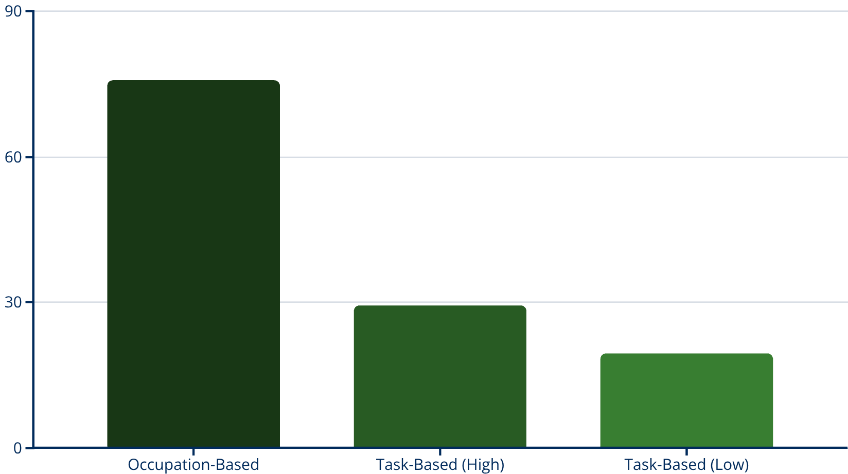
This isn’t just an academic difference. These numbers determine how much government funding the region receives, what types of training programs get developed, and whether communities panic or plan.

What the Research Found

The good news: most workers will keep their jobs. National research shows 79% of workers are in roles with low automation risk. AI is more likely to become a tool that helps people do their jobs better rather than replacing them entirely, “AI isn’t going to replace jobs, people who know how to use AI will”, stated Dr Lawler.

The challenges: different sectors are adapting at different speeds. Technology companies are racing ahead while schools and government lag behind. A quarter of workers are already using AI tools without any official training or guidelines, creating potential problems.

Regional areas like the Mid North Coast face specific hurdles. There are fewer opportunities to use AI as a productivity tool compared to cities. Administrative workers (many of whom are women) face higher automation risk, and older workers often lack confidence with digital tools.

The opportunities: businesses using AI early are seeing productivity improvements. Entry-level jobs remain stable. Most importantly, we’re still in the early stages of this transition, giving communities time to prepare rather than just react.

Taking Action

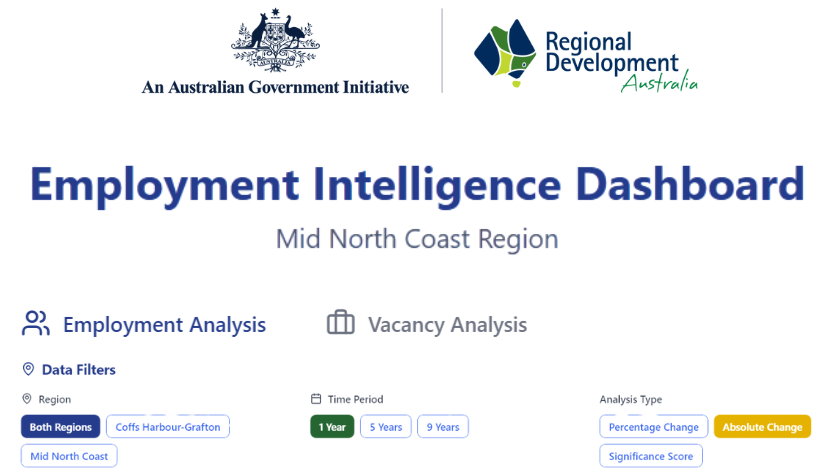
Rather than wait for change to happen, Dr Lawler conducted an AI experiment. Dr Lawler created an Employment Intelligence Dashboard using the Nowcast of Employment and Regional Occupations (NERO) dataset from Jobs and Skills Australia.

This tool monitors 355 different types of jobs in the region, showing which ones are being affected by AI and how quickly changes are occurring. Think of it as an early warning system that helps the region plan ahead.
September 2025 Taskforce Meeting

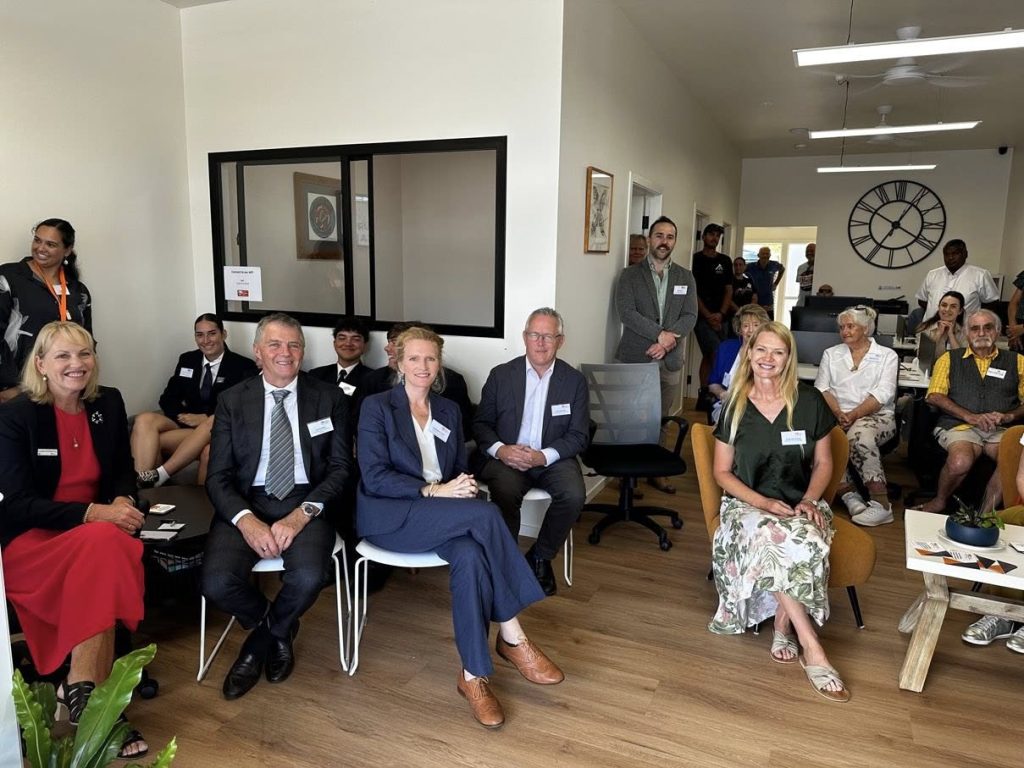
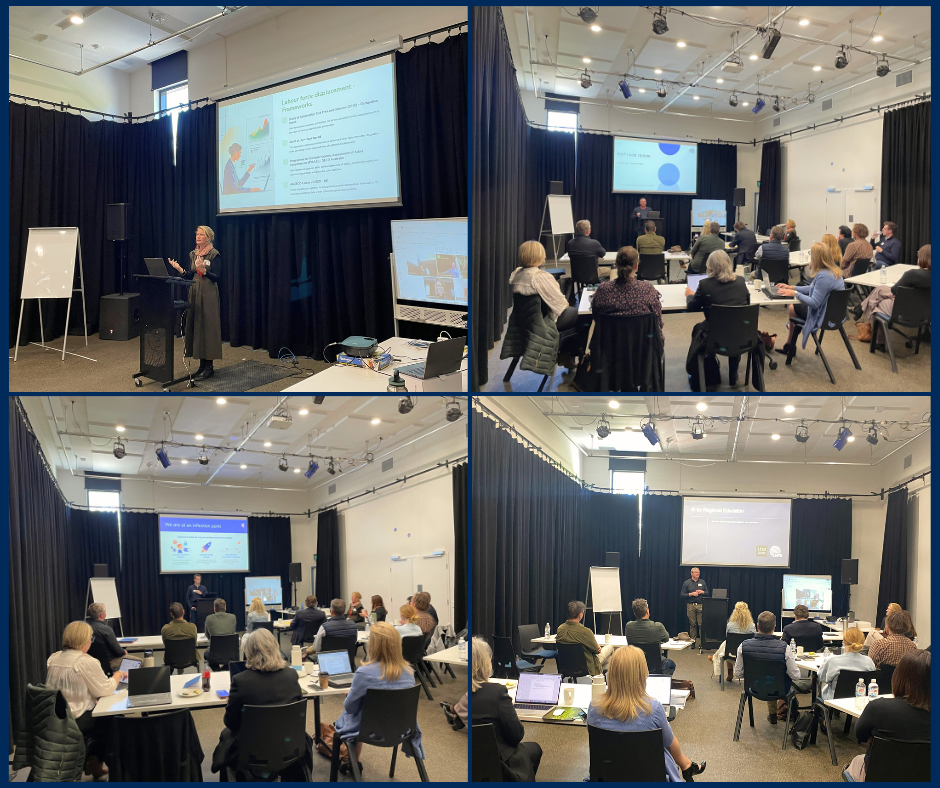
On 11th September 2025, Dr Lawler convened regional leaders at Bellingen Memorial Hall to address a central question: Would the Mid North Coast let AI happen to them, or shape how it happens?

Stakeholders from councils, academia, industry and community organisations shared current AI usage within their organisations, revealing varying levels of adoption and governance.

Infrastructure Presentations

NBN Co Regional Update: Chris Simon, Regional Manager Northern MNC, presented local network progress and AI’s impact on power grid infrastructure.

Telstra Connectivity Analysis: Regional Manager Joshua Fulwood outlined connectivity challenges and opportunities in regional Australia, including AI’s effects on internet and power consumption.

Digital Sovereignty Focus: University of New England’s Mitchell Smidt presented research on “shadow AI” usage in business and education. His presentation highlighted risks of uncontrolled AI adoption:

  • Intellectual property exposure
  • Security and privacy vulnerabilities
  • Competitive advantage erosion
  • Unintentional outsourcing

UNE’s response was developing “Madgwick,” a sovereign AI platform named after the university’s first vice-chancellor. The system provides NSW-based infrastructure with access to large language models while maintaining local data control.

“To combat the inequity and the shadow AI, we built a sovereign platform locked down to New South Wales where we can get access to any of the LLMs that we want,” Smidt explained.
Current Objectives

The taskforce aims to:

  • Develop AI capability across the region
  • Plan workforce redirection and transition strategies
  • Maintain community strength during technological change
  • Coordinate responses rather than leaving adoption to chance
  • Ensure regional advantages rather than disadvantages from AI development

Next Steps

RDAMNC continues stakeholder engagement across demographics and industries to develop plans reflecting the broader regional community. The organisation will provide periodic updates on taskforce progress and expand participation to include varied ages, backgrounds, genders and professional sectors.

Project Status

This is an active, ongoing initiative. The September meeting established foundations for continued collaboration. Future activities focus on building regional AI readiness while maintaining community cohesion and economic stability.

The taskforce operates on evidence that coordination surpasses isolation, and that regions still have time to influence AI outcomes rather than simply react to changes imposed from elsewhere.

To learn more about the AI Taskforce, explore RDA Sydney’s article here.

Circular Economy & Waste Management

What is a Circular Economy?

A circular economy is an economic model that focuses on maximising the use of resources by promoting the reuse, recycling, and remanufacturing of products, rather than following a traditional linear model of “take, make, dispose.” In a circular economy, the lifecycle of products is extended, and waste is minimised, fostering a regenerative system that benefits both the environment and the economy.

The key benefits of a circular economy include the reduction of waste, conservation of natural resources, and the lowering of carbon emissions. By redesigning products for durability, repairability, and recyclability, businesses can reduce their reliance on virgin materials, thus decreasing environmental impacts. Furthermore, circular practices can stimulate innovation, create new business opportunities, and contribute to job creation in recycling, remanufacturing, and repair sectors.

In the context of waste management, the circular economy enhances practicality by providing a systematic approach to divert waste from landfills and incineration. It encourages the development of sustainable waste management systems, including the use of technology to optimise recycling processes. This not only reduces the environmental burden but also creates economic value through the recovery of valuable materials, fostering a more sustainable and economically viable approach to managing waste.

Why is it so important now?

NSW is in a crisis. Within 10 years the city will be out of landfill capacity. Many Councils are currently trucking their landfill waste to Queensland. This is a situation that is dire. Every cubic metre of material saved from landfill matters. Right now only around 60% materials are diverted from landfill. Each year, 500,000 tonnes of soft plastic waste ends up in landfills. The NSW Government is setting targets for 80% diversion from landfill and a significant improvement in the use of circular solutions. This is why RDAMNC, iQRenew and Circular Australia are working to bring the vision for the circular economy to life on the Mid North Coast.

Circular Economy Panel at Ignite Minis 2025

The recent conference featured a comprehensive segment on the Circular Economy, led by Ash Sambrooks from the Department of Primary Industries and Regional Development. The discussion centred on the growing importance of circular economy practices in waste management, highlighting significant opportunities for businesses and communities in New South Wales to embrace a more sustainable, circular approach to resource management.

Ash Sambrooks presented waste statistics for New South Wales, noting that the state generates more waste than any other in Australia. With projections suggesting waste production could nearly double by 2041, the need for effective waste management strategies is increasingly urgent. The Circular Economy model, which focuses on minimising waste and maximising resource efficiency, offers a solution to these challenges. By adopting circular principles, businesses can reduce their environmental impact while unlocking new growth opportunities.

Liz Jeremy from Concatenation, highlighting strategies for designing out waste, extending product lifecycles through reuse and repair, and supporting natural ecosystem regeneration. Jeremy’s work underscores the critical role of circular economy principles in reducing emissions and enhancing the resilience of regional infrastructure, particularly in the face of growing extreme weather events.

The Norfolk Wave initiative, led by Lilli King on Norfolk Island, exemplifies circular economy success. The program has reduced waste, increased recycling rates, and empowered local communities through sustainable practices, including recycling glass into sand and using resin for concrete. In partnership with local organisations, the initiative aims to reach an 80% recycling rate by 2025.

Lilli King from The Norfolk Wave presenting at Ignite Mini, Valla Beach.

Graham Knowles, representative from iQ Renew and Circular Australia, outlined plans for a Regional Circular and Manufacturing Precinct at Kundle Kundle, set to become a hub for circular economy activities. By leveraging rail infrastructure, the project aims to reduce carbon emissions and improve waste processing efficiency. The precinct will foster innovation, create jobs, and help the region transition to a sustainable economy.

Q&A session with Ignite Mini’s Circular Economy Panel: Lilli King, Liz Jeremy, Graham Knowles.

Rail into Kundle Kundle

The Rail into Kundle initiative proposed by iQ Renew, is a transformative project designed to enhance waste management and boost resource efficiency for regional councils in New South Wales. By leveraging existing rail infrastructure, the initiative aims to create a Circular Economy precinct at Kundle Kundle, reducing transportation costs and carbon emissions while fostering sustainable manufacturing industries that use waste as a resource.

This project is crucial for the Mid North Coast as it addresses rising waste processing costs and logistical challenges faced by regional councils. It will provide a cost-effective solution by establishing a regional hub for processing recyclables and organic waste, reducing reliance on landfill and virgin materials. Additionally, the project aligns with national sustainability goals, contributing to emissions reductions and economic growth.

The benefits of the project include local job creation, reduced carbon footprint (up to 16 times less than road transport), and the stimulation of local industries through waste-to-product manufacturing. It will also support NSW’s sustainability targets and Circular Economy objectives by diverting significant amounts of waste from landfills and encouraging innovation in recycling technologies.

Regional Development Australia Mid North Coast is supporting the project due to its potential to drive economic growth, create local employment, and help regional communities transition to a sustainable circular economy. By fostering collaboration between councils, industry stakeholders, and government agencies, the initiative promises long-term environmental and economic benefits for the region.

Group General Manager of iQ Renew, Graham Knowles, delivering his presentation at Ignite Mini, Valla Beach, NSW.

RDAMNC Project Details

Regional Development Australia Mid North Coast (RDAMNC) has actively advocated for the adoption of a Circular Economy in the region via iQ Renew’s ‘Rail to Kundle’ initiative. We have highlighted key local leaders within industries, showcasing their expertise and insights at various events. These leaders have been promoted to stakeholders both within and outside the region to build a network of support for sustainable practices. RDAMNC is currently lobbying government bodies to secure funding for circular economy initiatives, with a specific focus on a grant application. The outcome of this grant will be communicated later this year, marking a significant step towards advancing circular economy initiatives in the Mid North Coast, fostering long-term sustainability and economic growth for the region.

RDAMNC CEO, Madeleine Lawler, discussing the organisation’s involvement in the Rail to Kundle project.

The Welcome Experience

Regional Development Australia Mid North Coast (RDAMNC) is pleased to have received the tender to host The Welcome Experience (TWE) across Port Macquarie, Kempsey and Nambucca Valley regions between 2024 – 2026. TWE’s purpose in the Mid North Coast is to address the vacant positions in essential services (health care, education, emergency services, justice, child protection as well as domestic and family violence) that are affecting the quality of life of our regional area.

The Welcome Experience (TWE) is a comprehensive initiative aimed at improving the relocation process for essential workers and their families to the Mid North Coast (Port Macquarie, Kempsey and Nambucca Valley). RDAMNC’s role is to foster collaboration among key stakeholders, including those from health, education, community services, justice, emergency services, and other organisations and community groups. The goal is to make the Mid North Coast an attractive, supportive destination, enhancing both regional growth and community well-being.

RDAMNC has employed two new staff members, Helen Mansfield (Local Connector) and Charlee Weston (Project Support Officer), to ensure participants of TWE are assisted by Mid North Coast locals, who’ve been trained in direct correspondence with the Department of Primary Industries and Regional Development (DPIRD), whilst receiving the support of RDAMNC.

Help Essential Workers with…What does this look like?
Relocation AssistanceHelping with logistical aspects such as finding housing, understanding local services, and navigating the moving process.
Orientation ProgramsProviding information and resources about the local community, cultural norms, and essential services.
Community IntegrationFacilitating opportunities for newcomers to connect with residents and other essential workers to build a supportive community network.
Professional IntegrationAssisting with the transition into local professional environments, including understanding regional practices and connecting with local professional networks. 

The Welcome Experience is a free service supporting essential workers (and their families) who are considering applying for or have accepted a job in regional NSW.

Government and non-government employees in the following industries are eligible for The Welcome Experience:

  • Health
  • Aged Care
  • Education
  • Early Childhood
  • Disability Support
  • Child Protection and Out-of-home care
  • Corrections and Justice
  • Emergency services
  • Rural Fire Service
  • Veterinarians

NSW Government employees of the following agencies are also eligible: 

  • NSW Police
  • NSW Fire & Rescue
  • NSW Ambulance
  • NSW Health
  • Department of Education
  • Department of Communities & Justice.

If you are considering making the move to the Mid North Coast and are wanting to receive the FREE benefits of The Welcome Experience, submit your interest today!

Country Universities Centre Norfolk Island

COUNTRY UNIVERSITY CENTRE NORFOLK ISLAND OFFICIALLY OPEN

Country University Centre Norfolk Island was officially opened on Friday 12th December 2025, marking a significant milestone for tertiary education access on the island.

The launch event brought together key speakers including Michelle Sanson, David Buffett, Madeleine Lawler, Chris Ronan, Lotus Rana, Jane Evans and David Smith MP, who officially declared the Centre open.

The Centre welcomed Michelle Sanson as Centre Manager and Lotus Rana as Learning Support Officer from 10th December 2025, returning the Centre to full-time coverage.

Both appointees bring valuable experience from Australian universities and strong connections to the Norfolk Island community. They will be joined by Learning Support Officers Andrew Seaton and Zara Elliott in the new year.

Whether you’re considering study or need support with current studies, visit the team at 72 Taylors Road to explore your options.

Update: 03/02/206

The Country Universities Centre Norfolk Island (CUCNI) is progressing steadily, with all key positions now successfully filled. Following a strong response from both local and mainland applicants, the recruitment process has been completed.

We’re pleased to announce Sally-Ann Thompson’s appointment as Centre Manager for CUC Norfolk Island, commencing 1st September 2025. With extensive educational leadership experience and local knowledge, Sally will strengthen the CUC’s commitment to bringing quality tertiary education opportunities to Norfolk Island families and the broader regional community.

The fit-out and project management of the Centre is also moving ahead, with contractors appointed and preparations underway to ensure the Centre is ready for its anticipated September 2025 opening.

Once operational, CUC Norfolk Island will provide important opportunities for casual and volunteer roles, offering learning and technical support to students and strengthening local access to tertiary education.

Click the link to read Norfolk Island’s CUC media release.

Update 24/06/2025

The Australian Government has announced the creation of a Regional University Study Hub on Norfolk Island, led by Regional Development Australia Mid North Coast (RDAMNC). This new initiative, the Country University Centre Norfolk Island (CUCNI), marks the first time island residents will have access to university-level education locally. Part of a $66.9 million national investment, the new hub is one of 10 Regional University Study Hubs designed to bring tertiary education closer to regional, rural, and remote communities. The hub offers new opportunities for young people and mature-aged students, enabling them to study without leaving home and pursue career or educational advancement in their own community. The CUCNI Board, including David Buffett, Sharon Nicol, Mary Christian-Bailey, Margaret Christian, Gaye Evans, Susan Prior, Chris Ronan (CUC), and Madeleine Lawler (RDAMNC), is dedicated to supporting Norfolk Island’s educational growth and ensuring residents have the same access to higher education as those on the mainland.

For additional information, read RDAMNC’s Media Release of the CUCNI.

Update 04/02/2025

Throughout the year, our team at RDA MNC has engaged with local residents, stakeholders, and state government representatives to develop a Countries Universities Centre (CUC) on Norfolk Island. In October 2024, we finalised and submitted the application for the construction of this new facility to Regional University Study Hub. We are eager to keep the community updated on the progress of our application. Our goal is to ensure that the residents of Norfolk Island gain access to state-of-the-art tertiary education services, similar to those available on the mainland.

Update 29/11/2024

During the very early stages of the recent Residential Visit on Norfolk Island by RDAMNC CEO, Madeleine Lawler, the repeat challenge of access to vocational education and training and higher education for Norfolk Islanders was raised. The team has initiated a Regional University Study Hub Grant application with the Country University Centre team in order to improve access to post-secondary education on Island.

Update 4/7/2024
Visit our update – CUC for Norfolk Island – RDA & CUC Board need your support – Regional Development Australia – Mid North Coast NSW (rdamnc.org.au) – for how you can support this.

More information will be shared once this project progresses.

Early Childhood Education and Care on the Mid North Coast

RDAMNC has submitted a formal letter to the Australian Government advocating for equitable access to funding for all Early Childhood Education Centres (ECECs), including for-profit providers. Currently, many government grant programs exclude for-profit services, despite their significant role in regional areas.

According to the Mitchell Institute, over 60% of regional communities in Australia are classified as ‘childcare deserts’—areas with more than three children per available childcare place (Pascoe & Jackson, 2022). This funding gap contributes to the Mid North Coast’s limited access to early learning.

RDAMNC supports greater inclusion to ensure childcare centres can meet community and workforce needs and hope to update our region with a positive outcome.

Update: 24/06/2025

As part of the Regional Investment Framework (RIF), “Services” is now one of main areas identified by the Government for RDAs to focus on. One service that was identified was early childhood education and care. To obtain an understanding of the situation in our region, RDAMNC conducted a survey of both childcare providers and parents in September 2023.

RDAMNC have prepared a quantitative and qualitative summary of both surveys which can be viewed here.

This is the first part of our work in this area with follow up to come in the form of:

  • Consultation with peak body and government representatives.
  • Engagement of Martin Musgrave (economist) to analyse the economic impacts to providers, families and businesses. Click here to view a copy of the report.
  • Workshops (in February 2024) with stakeholders to look at opportunities in the region to increase supply.
  • Advocacy report on the surveys, consultations, economic analysis and workshop outcomes.
  • Exploring opportunities for a pilot program focused on alternative childcare models.

This project will be ongoing due to its social and economic impact on the region’s well-being

Norfolk Island Local Produce Branding Project

During the Tourism and Wellbeing Business Incubator of 2022, a “made in Norfolk” brand was again raised as a priority to identify the products and produce that has been locally made and grown.

RDAMNC saw the opportunity to work with a branding and media agency engaged to undertake the Norfolk Island Destination Marketing project, to ensure that the “made in Norfolk” brand was harmonious and linked to destination marketing.

This will produce an exciting identity for the creations of Norfolk Island, making it easy for tourists to shop locally and support the domestic economy of Norfolk Island.

Mid North Coast Skills Audit

Mid North Coast Faces Significant Labour and Skills Shortages, New Study Reveals

A recent study commissioned by Regional Development Australia Mid North Coast (RDAMNC) and undertaken by Charles Sturt University (CSU) has highlighted the escalating labour and skills shortages across the region, presenting a major challenge to its economic growth. The 2024 Skills Audit, released today, identifies several critical issues, including workforce shortages, skill gaps, limited vocational training opportunities, and infrastructure constraints such as housing affordability and access to early childhood education.

The audit reveals that the Mid North Coast (MNC) has a lower proportion of working-age individuals compared to the state average, making it increasingly difficult for businesses to find the skilled workforce they require. Simultaneously, the region is experiencing a notable outflow of skilled professionals, particularly in sectors such as healthcare, aged care, and construction. Moreover, the study highlights the region’s limited access to vocational training, which forces many workers to travel to larger cities for education and development.

Other key challenges outlined in the report include the lack of affordable housing, limited childcare services, and inadequate infrastructure such as transport and digital connectivity—factors that significantly hinder both workers and businesses in the region.

The study puts forward several actionable recommendations to address these challenges, including:

  • The development of a cohesive regional housing strategy that aligns with workforce planning.
  • Ensuring universal access to Early Childhood Education and Care (ECEC) to support workforce participation, particularly for women.
  • Strengthening the regional skills ecosystem through closer collaboration between employers, training providers, and community services.
  • Enhancing infrastructure to improve transport, housing, and digital connectivity across the region.

These recommendations aim to provide a strategic framework to overcome the region’s current barriers and foster sustainable economic growth for the Mid North Coast.

View the 2024 Mid North Coast Skills Audit HERE.

View the Snapshot of the 2024 Mid North Coast Skills Audit HERE.

View the Media Release of the 2024 Mid North Coast Skills Audit HERE.

Updated: 21/03/2025


One of the four pillars in the Regional Investment Framework (RIF) is Investing in People. Within the definitions provided by the RIF the education, availability and accessibility of people is captured. These two projects are proposed as the 2023-2024 lead projects to assist RDAMNC and our stakeholders understand the labour market features properly.

The last skills audit conducted on the Mid North Coast was 2019. The significant international, national and local events which have transpired since that time have had an impact on the labour market. The workforce challenges of skills and workforce attraction have now shifted to a full shortage in people, housing, skills, accessibility of training packages and worse linkages between industry and education institutions. The team at RDAMNC has partnered with Charles Sturt University to deliver this research project.

This project will assist us in gathering the necessary information to establish projects that will assist in the areas prioritise by our stakeholders across the region and a preliminary report on findings will be available after September 2024. The final reports will be academic, peer reviewed papers which are planned to be available in 2025.

Labour Participation Study

One of the four pillars in the Regional Investment Framework (RIF) is Investing in People. Within the definitions provided by the RIF the education, availability and accessibility of people is captured. This project will be one of the 2023-2024 lead projects to assist RDAMNC and our stakeholders understand the labour market features properly. RDAMNC has commissioned the Regional Australia Institute to understand the real figures associated with labour participation in the Mid North Coast.

The participation rate for the Mid North Coast is the worst in NSW. In May 2023 it was 47.1%. The rest of NSW was 66%. This is an indication of a structural difference in the MNC labour market that needs to be investigated. This project will enable us to do the following:

  1. Compare the participation rates of the Mid North Coast LGAs with regional NSW, the whole State and Australia, and
  2. Analyse the participation rates of different demographic groups in the region, to identify specific participation challenges.

RAI completed their report into the labour force participation in December 2023. A copy of the report can be viewed here.

For further information on how we are continuing to Invest in People, MNC Skills and Labour, please visit our project Mid North Coast Skills Audit.